

Replacing the SSD in your laptop is a familiar upgrade: more storage, a faster drive, or both. Step-by-step guides for the installation itself are easy to find, from your laptop's manufacturer to major tech retailers. Where most of those guides stop is exactly where this article picks up: what do you do with the drive that comes out? That question is worth considering, because throwing away a working SSD or hard drive is a waste: with the right enclosure, it becomes a fully functional external drive in a few minutes.
First things first: what type of drive was in your laptop?
A laptop contains one of two types of drives:
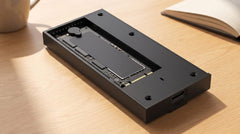
- M.2 SSD: a narrow circuit board a few centimetres long, mounted directly on the motherboard.
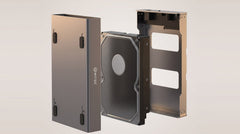
- 2.5-inch SATA drive: a rectangular case, about the size of a pack of gum, as a hard drive or SSD.
A 3.5-inch drive doesn't occur in a laptop: that size is reserved for desktop PCs. Not sure which type your laptop had? Look at the drive itself once you've removed it: a narrow card is M.2, a rectangular block with connector pins on one side is 2.5-inch. Still unsure, or want to work through the full three-step selection guide (size, connector, speed)? Which enclosure do I need for my old hard drive? can help with that.
How an SSD replacement generally works
The exact procedure differs per laptop brand and model, so this is general technical background, not a Switss product step. In broad terms, it comes down to this:
- First back up the files you want to keep (the step that's skipped most often, and regretted most if something goes wrong).
- Turn off the laptop, unplug it, and if the laptop has a removable battery, remove that too.
- Open the bottom panel according to the manufacturer's instructions and locate the existing drive.
- For an M.2 SSD: unscrew the retaining screw and gently pull the SSD out at a slight angle. For a 2.5-inch drive: unscrew the mounting frame and disconnect the cable.
- Fit the new SSD, close the laptop back up, and either reinstall the operating system or clone the old drive onto the new one before removing it.
Not sure about a specific step for your laptop? Check the manufacturer's manual or consult a certified repair technician: this overview is deliberately general, since the exact process varies by model.
Why not simply throw away the old drive
The drive you just removed from your laptop still works fine in most cases: it was replaced because it had become too small or too slow for its job as the main drive, not because it's broken. As an external drive for photos, documents or an extra backup, it still has years of use left in it. That saves you a new purchase, and a working drive doesn't belong in electronic waste.
Which enclosure fits your old drive?
Prices and specifications below were checked on switss.nl on 24 July 2026. Check the product page for the current price.
| M.2 SSD enclosure with heatsink | 2.5" HDD/SSD enclosure | |
|---|---|---|
| Suitable for | M.2 NVMe (PCIe) or M.2 SATA (NGFF), sizes 2230/2242/2260/2280 | 2.5-inch SATA HDD or SSD, any brand |
| Connection | USB-C 3.2 Gen 2, 10 Gbps | USB-C (USB 3.0, UASP) |
| Speed | up to 1050 MB/s read with NVMe; up to around 500 MB/s with SATA | up to 450 MB/s with an SSD; 100-180 MB/s with an HDD |
| Max. capacity | up to 2 TB | up to 4 TB |
| Mounting | tool-free, clicks into place | tool-free, clicks into place |
| Material | aluminium with heatsink | aluminium with passive cooling |
| Colours | [SPEC UNKNOWN: owner to fill in] | black, silver, pink, blue |
| Price | €18,99 | €12,49 |
UASP (USB Attached SCSI Protocol) is a transfer protocol that sends data over USB faster and more efficiently than the older standard.
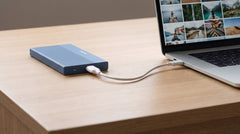
Both enclosures are supplied without a drive: your own SSD or hard drive clicks in without tools.
Step by step: from internal to external drive
If you removed an M.2 SSD from your laptop, the article Turn an M.2 SSD into an external drive: step by step sets out the exact steps for you: fitting the SSD, connecting the cable, and getting the drive ready to use. If it was a 2.5-inch drive, Reusing an old 2.5-inch laptop drive as an external drive walks through the same steps for that size.
What about the files still on it?
If you're going to use the old drive yourself, for example as an extra backup, there's nothing to wipe: the files simply stay in place and remain accessible once the drive is in the enclosure. If you want to give away, sell or dispose of the drive, first carefully wipe all personal files; simply deleting them to the recycle bin isn't enough, since deleted files can often still be recovered with the right software. Not sure whether everything you want to keep is already stored somewhere else? The article "Reading an old hard drive: how to view the files on a loose HDD or SSD" walks through how to check the contents before you transfer or wipe anything.
If you'd rather move the files from the old drive straight to your new laptop, without a cloud subscription, the article "Transferring files to your new computer: the simple way without cloud storage" covers that step separately.
Frequently asked questions
Can I just use my old SSD in an external enclosure?
Yes, as long as the size and connector match: an M.2 SSD in sizes 2230, 2242, 2260 or 2280 goes in the M.2 enclosure, or a 2.5-inch SATA drive goes in the 2.5" enclosure. The M.2 enclosure works with virtually any SSD brand (tested with, among others, Crucial, Samsung, Kingston and Intel); the 2.5" enclosure works with any drive brand.
Do I need to wipe the old drive before reusing it?
Only if you're giving away, selling or disposing of the drive. If you keep using it yourself, nothing needs to be wiped.
Is the old drive in an external enclosure just as fast as when it was in my laptop?
That depends on the drive type and your computer's connector. An M.2 NVMe SSD reaches up to 1050 MB/s in the enclosure, a SATA SSD up to around 500 MB/s, and a 2.5-inch hard drive 100 to 180 MB/s, comparable to the speed the drive reached internally, limited by your computer's USB connection.
Can I use a different SSD in the same enclosure later on?
Yes. Both enclosures are supplied without a drive, so you can swap the old drive for a new one later.
How much warranty do I get on the enclosure?
2-year manufacturer's warranty, with Dutch customer service.
Next step
Now you know which type of drive came out of your laptop? Check the specifications and current price: Switss M.2 SSD enclosure with heatsink for an M.2 SSD, or Switss 2.5" HDD/SSD enclosure for a 2.5-inch SATA drive.