

You have an old hard drive lying around, from a computer that became slow, or one you got rid of during a move or a clear-out. It probably has photos on it that you don't want to lose. Before you spend €12,49 or €29,99 on an enclosure, you naturally want to know: is this worth it? Or has the drive stopped working after all?
This article helps you assess that with a few simple checks. No tools needed, no technical knowledge required. What it isn't: a guarantee, and not a substitute for a professional data recovery service (a company specialised in retrieving files) if the drive is clearly broken. Does the drive turn out to be worth pursuing? Then the guide "Rescuing photos from your old computer: the complete step-by-step guide" walks you through the rest of the process. The guide "Reading an old hard drive: how to view the files on a loose HDD or SSD" shows you how to actually get to your files afterwards.
The good news: the drive usually still works
This is general experience from the tech repair trade, not a measured Switss or research figure. A computer is usually replaced because it became slow or outdated as a whole, not because the hard drive specifically failed. Slow start-up times, an outdated operating system, or simply needing a new laptop: those are different reasons than a faulty drive.
As a rule of thumb: did your old computer keep working normally right up to the end? Files opened as usual, there were no strange noises, and you didn't get any error messages about the drive. Then it's unlikely that the hard drive itself was the problem. The rest of this article helps you check that further.
The key question: how did your old computer stop working?
Before you order anything, it helps to think back to how that old computer reached the end of its life. Do you recognise your situation in one of the two categories below?
Reassuring signs
- The computer gradually became slower over time, without anything actually breaking.
- You replaced the computer with a new one while the old one still worked fine.
- Files and photos could still be opened normally right up to the end.
If this sounds like you, there's little reason to assume the hard drive specifically was the problem.
Signs to take seriously
- At some point, the computer stopped starting up altogether.
- You received error messages specifically about the drive.
- The computer froze regularly, shortly before it stopped working altogether.
- You heard a clicking or grinding noise, shortly before the computer gave out.
Do you recognise any of these signs? That doesn't automatically mean everything is lost, but it is wise to adjust your expectations. Read on for the checklist and the explanation about noises below.
Five things to check before you order (without opening anything up)
Get the drive out and go through these five points. You don't need to unscrew or take anything apart:
- Is the drive visibly damaged? Think dents, or a cracked or broken casing.
- Has the drive ever been dropped, or got wet? Even a long time ago counts.
- Does the drive smell burnt? A scorched smell is a clear warning sign.
- Are the connector pins straight? Check that they aren't bent or damaged.
- Do you remember whether the drive felt very warm or hot during use? That can be a sign that something wasn't right.
None of these five points is a guarantee on its own. Is everything fine? That's no guarantee the drive does work. Did you spot something odd? That's no guarantee it doesn't work either. Together, though, the five points give you a good picture of the risk before you order.
What a clicking or grinding noise means (and why this is different for an SSD)
A hard disk drive (HDD) has moving parts inside: a spinning platter and a read head that moves across it. A clicking or grinding noise during use can therefore point to a mechanical problem.
An SSD works differently: it has no moving parts and therefore makes no noise at all, even when it's completely fine. Do you know your drive is an SSD? Then noise tells you nothing about the state of the drive.
Not sure whether you have an HDD or an SSD? You don't need to know for choosing your enclosure either: the article "Which enclosure do I need for my old hard drive?" explains that both enclosures work with an HDD as well as an SSD.
Still not sure? Why trying it is low-risk
Have you gone through all the checks above and are you still not sure? That's understandable. With the naked eye, and without connecting the drive, you can never be completely certain. Fortunately, the investment is limited: €12,49 for a 2.5-inch enclosure (for a laptop drive), or €29,99 for a 3.5-inch/2.5-inch enclosure (for a desktop drive). Prices checked on switss.nl on 24 July 2026.
In practice, connecting the drive itself is safe: it doesn't change anything that's already on the drive. And if you decide against it or change your mind: both enclosures come with a 2-year manufacturer's warranty and 30 days to return it.
Which enclosure fits your drive?
Once you decide to give it a try, the size of your drive is the only question that remains:
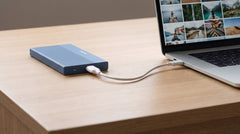
- 2.5-inch: flat and compact, usually from a laptop. Powered through the USB cable itself; you don't need a separate adapter.
- 3.5-inch: larger and heavier, usually from a desktop PC. Needs the included power adapter.
Still unsure about the size, the connection or the speed? The article "Which enclosure do I need for my old hard drive?" walks you through the full three-step selection guide. Want to see the two enclosures compared in more detail, with speed and capacity in one table? The article "Hard drive enclosure: 2.5-inch or 3.5-inch, which size do you need?" lays them out for you.
Frequently asked questions
Can I tell whether my old hard drive still works without connecting it first?
Not with complete certainty, but you can get a good picture. Three things together give a reasonable estimate of the risk: how your old computer stopped working, whether the drive is visibly damaged, and whether it made clicking or grinding noises. You only get certainty once you actually connect the drive.
My old computer stopped working: does that mean the hard drive is broken too?
Not necessarily. A computer is often replaced because it became slow or outdated as a whole, not because the hard drive specifically failed. Did the computer keep working normally until the end? Files opened, and there were no strange noises or error messages. Then it's unlikely the drive itself was the problem.
What does a clicking or beeping noise from my hard drive mean?
For a hard disk drive (HDD), that can point to a mechanical problem, because an HDD has moving parts. An SSD has no moving parts and makes no noise at all, so for an SSD, noise tells you nothing about the state of the drive.
Do I lose my money if the drive turns out not to work after all?
No. You have 30 days either way to return the enclosure. And if your old drive turns out not to work after all? Then you'll still have a working enclosure at home for a future drive.
Is it safe to just try connecting an old hard drive?
Yes. Connecting it doesn't change anything that's on the drive. Based on the checklist above, do you have serious doubts about the physical condition (visible damage, a strange smell, a clicking noise)? Then consider a professional data recovery service rather than continuing to try it yourself.
How much warranty do I get on the enclosure?
A 2-year manufacturer's warranty, plus 30 days to return it.
Next step
Have you gone through the checks and do you want to give it a go? Check the specifications and current price: Switss 2.5" HDD/SSD Enclosure (€12,49) for a laptop drive, or Switss 3.5"/2.5" HDD/SSD Enclosure (€29,99) for a desktop drive. Prices checked on switss.nl on 24 July 2026.
Want to go straight from this diagnosis through the whole process, from checking to actually having your photos back? The guide "Rescuing photos from your old computer: the complete step-by-step guide" takes you through it step by step.